iHopes
2025/12/24. An iPolar device arrived yesterday in good shape. I'm pretty sure that slack polar alignment underlies the angst I experience while finding targets with the Wave 100i. This should resolve that and give me an additonal half hour of clear skies every time I go out to image. I stole a USB Mini B cord from the charging drawer to verify that its firm- and software run without complaint on the telescope control computer. I put myself to sleep designing a bracket to allow the iPolar to share the Wave 100i's secondary saddle with the guide 'scope and counterweights.
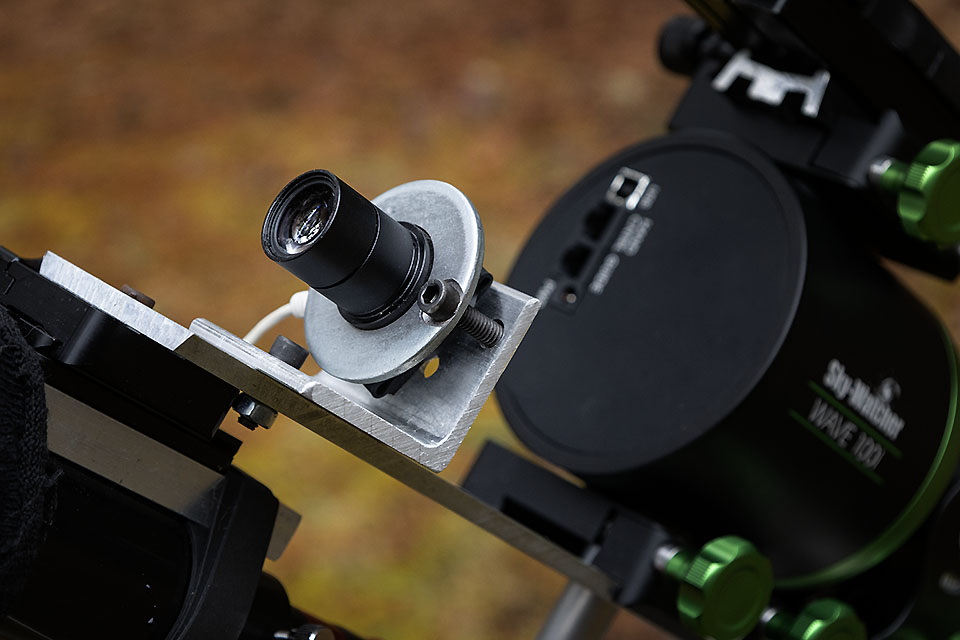
iPolar mounted on secondary saddle which it shares with
a 50mm guidescope and ASI120MM mini camera.
Bracket 1.00 is nothing fancy. Ease of construction guided the design. I started with a heavy steel fender washer and a short section of aluminum angle stock. I enlarged the inside diameter of the washer from 0.93 to 1.15 inches to allow all but the largest shoulder of the iPolar to pass through. To do that, I mounted a boring bar on the lathe's new quick change tool post -- a novelty to me. This beats flipping the tool and cutting on the back side of the work all to thunder. True to the "quick change" monicker, this took literally seconds, including time to adjust the tool's height (first time use). Drilling and tapping for a couple of small bolts would have been nice, but in the moment a pair of 1/4x20 socket head bolts and matching hex nuts did the trick. Four layers of thin, firm rubber behind the iPolar provide a little shock absorption and keep a bit of tension on the mounting nuts.
2025/12/27. A warm midwinter night with too much Moon for real DSO hunting gave me a chance to try out the iPolar. There are a few tricks I have not seen made clear in any online tutorials. Getting it to play with the Wave 100i involves a few more.
First: remember that my bracketry 1.00 (above) is co-mounted with the guide-scope. The iPolar points where the guide scope points. If the mount were to do a meridian flip during the polar alignment process, I have no idea if the iPolar s/w could cope. So don't let that happen. It is necessary to do at least a 1-star alignment (or to pretend to do one) in order to get the mount to accept and follow the RA slew commands required to define the center of rotation for the iPolar software.
Second: after the requisite 1-star alignment, don't forget to do an auto-home before starting the iPolar alignment process. Otherwise, the software will try to identify some whackass starfield near the alignment star using its database of near-polar stars. That's not going to work. Send the mount home and then let the iPolar app plate solve. Accept position one; then slew 45 degrees (or so) east or west, and accept position two; slew again to a similar position in the opposite direction, and accept position three. Done. That establishes the mount's RA axis with respect to the polar 'scope's field of view. The center of rotation -- where the RA axis is pointed -- is shown in the app as a red cross. (Having done this once, you may not need to do it again until messing around with the iPolar attachment bracket. So don't do that, either.) After defining the RA axis, you can do an easy and precise polar alignment by using the altitude and azimuth knobs. Bring the red cross into alignment with the red dot that the app uses to mark the celestial pole; tweak until the combined icon turns green.
Third: be aware that if you then immediately slew to a target, the mount may not be tracking. It just depends on what's happened since sending the mount home. There may be a way to start it up short of what I did, but the mount expects its work is done after performing an auto-home. I performed another star-sync to get the sidereal drive re-engaged, and then slewed back to M31.
Take all that advice with a grain of salt. I've only done it once so far.
After this, PHD2 had some trouble connecting to the ASCOM SyncScan app. Coincidence or unappreciated interference? It's not clear that closing the iPolar app released the ports PHD2 wants. It's not clear that it didn't release them, either. Something went awry. I resolved all the connection issues in the usual way: I closed all the s/w and relaunched what I needed in the confidence that powering up the kit with good polar alignment already done would be straightforward, and it was.
[This occured again on 1/12/27, and I eventually resolved in much the same way after an hour of kicking dirt. After starting the SynScanPro app, the mount can be told to begin tracking without the nuisance of performing or miming a one-star alignment: Utilities/Tracking/Sidereal Tracking.]
This is all a little alien compared to the A-P way. That said, with the mount reasonably level and well aligned on the pole, a casual 1-star alignment allowed SyncScan to put M31 on the chip, first try, and after convincing PHD2 that it could indeed connect to the mount, the total guide error (with Dec & RA aggression set to 100, and with guide exposures of 1 second) was right at one second of arc (spells of 0.6" combined RMS were common enough). Let's say this night was a bit of a mess but eventually successful and relatively stress-free.
I didn't keep any images owing to the Moon and passing clouds. For the record: single 30s F2.8 ISO 1600 subframes with the Canon R6 under this somewhat Moony and not entirely transparent sky showed galaxies which Guide lists as Mag 15. Stars between 15 and 16 are clearly visible. That's well outside the central sweetspot, with slightly sloppy focus, near one corner, where I was looking for (and not finding) an accidentally included comet. The adventures of the non-tracking mount had the happy effect of reframing the field to include both M31 and fragmenting comet 2025 Atlas K1 which I last imaged almost two weeks ago (see previous page).
2025/12/29. I recovered those files to take a closer look for the fortuitously placed comet after seeing a perfectly fine photo of it from about the same time as mine. In a search of the first, best 60 frames, stacked, aligned, aligned on predicted movement, etc, I still didn't find the comet. But I do today give Google credit for finding on Reddit a really nice program for recovering files from HDDs, SDDs, and SDs after hasty, mistaken, accidental, or otherwise unfortunate erasure. It's supposed to also help recover data after some kinds of damage. The s/w at the link just below worked like a charm in this case, and it really was, for once, actually free to use for noncommercial purposes:
www.r-undelete.com/downloads/RPhoto2.exe
I make no warrantees, implied, suggested, hinted at or otherwise imagined to be within the scope of this conversation -- it worked for me and it does not appear to have destroyed my OS or inserted tracking chips into my cerebellum.
2025/12/30. I took a third look. Radically stretched stacks pulled the rabbit out of the hat, which left me with a day-long project to make it good. The best technique turned out to be (1) use Guide to measure the anticipated movement of the comet; (2) do a comet alignment of the star-aligned frames by plugging the numbers from the first step into the algorithm -- in this case, 14 pixels south and 0 pixels east or west worked well to deal with movement during the 30 minutes of exposure; then (3) SCNR to remove excess green; (4) gradiant correction, (5) blur exterminator which both focused the nasty stars and got rid of the short trails introduced by step 2; (6) stretch and faux-flat as needed for the galaxy and stretch some more in the vicinity of the comet. Nothin' to it:
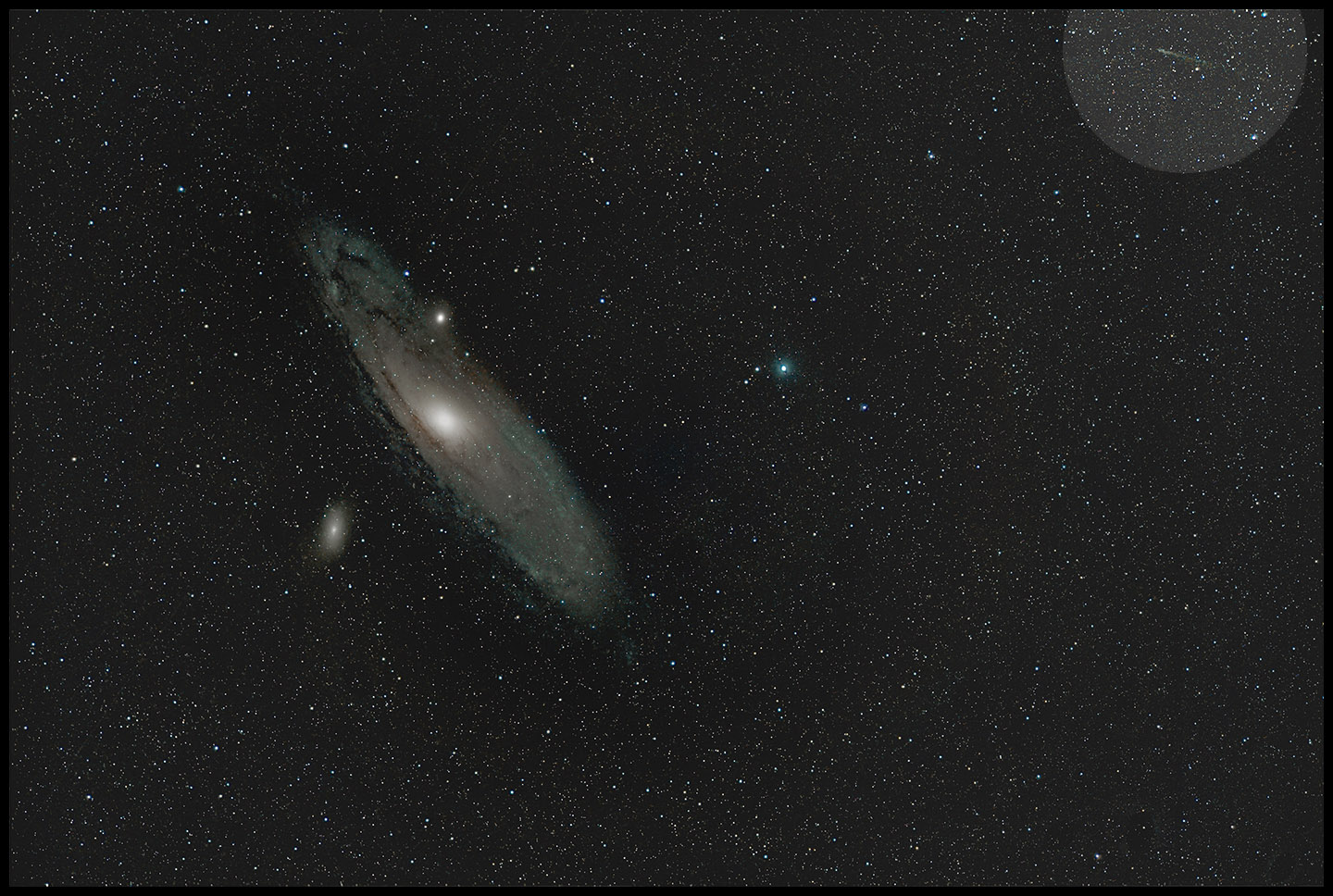
60x30s, 400mm F2.8 Nikkor, Canon R6 @ ISO1600, Wave 100i.
If we take the apparent magnitude of M31 to be 3.4 and Atlas K1 to be 14.5 (per an online repository of comet observations), then on this night the comet was 27,000x fainter than the galaxy. (www.aerith.net/comet/weekly/current.html)
:: top :: |