Technical Details,
Sacajawea Sits for a Portrait
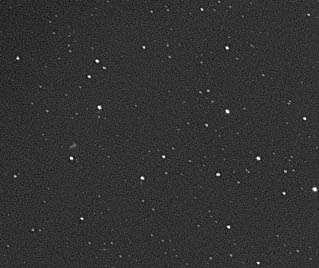
One 5-minute exposure showing a small part of the
constellation Libra. The field is about the size of the Moon.
Somewhere in the frame is the asteroid 2822 Sacajawea. Hard to see? You bet: at the
time, it was 221,000,000 miles from Earth, and the asteroid is only 18 miles
in diameter.
The brightest star in the field is magnitude 12.3 (at least 100x too faint
to be seen by the unaided eye). The fuzzy patch at left is 15th magnitude galaxy IC 1119.
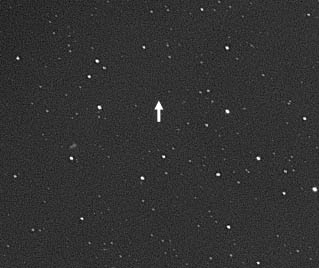
Same frame, 2822 Sacajawea arrowed.
Don't squint too hard, it's practically invisible on a single frame even when viewed at full scale. The asteroid is magnitude 17.4, or about 100x fainter than the brightest star in the frame.
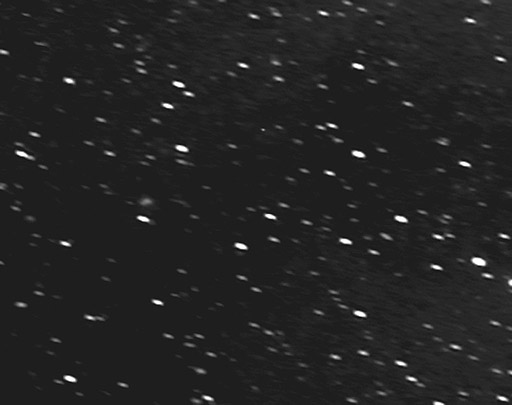
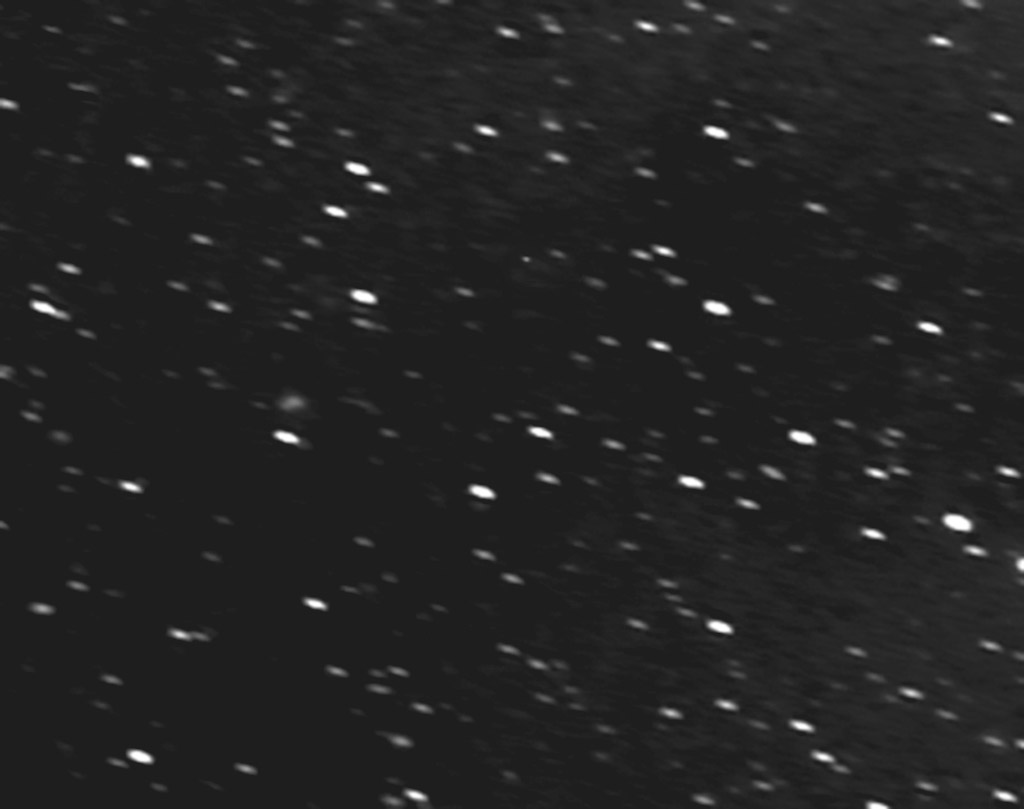
Four 5-minute exposures offset and summed.
(Click on the image for a larger version.)
The only way to make a clear photo of a faint, moving object is to
follow its motion, either with the telescope or by digitally aligning the data
later. To make this photo, four consecutive 300 second exposures
have been re-aligned to compensate for the asteroid's motion. By
summing the light intensities in the offset images, all the sunlight
reflected from 2822 Sacajawea combines into a sharp 20-minute
exposure while background stars trail.
I registered each frame on the asteroid's faintly visible image
using 1-star alignment in Diffraction Limited's Maxim v4.07 software.
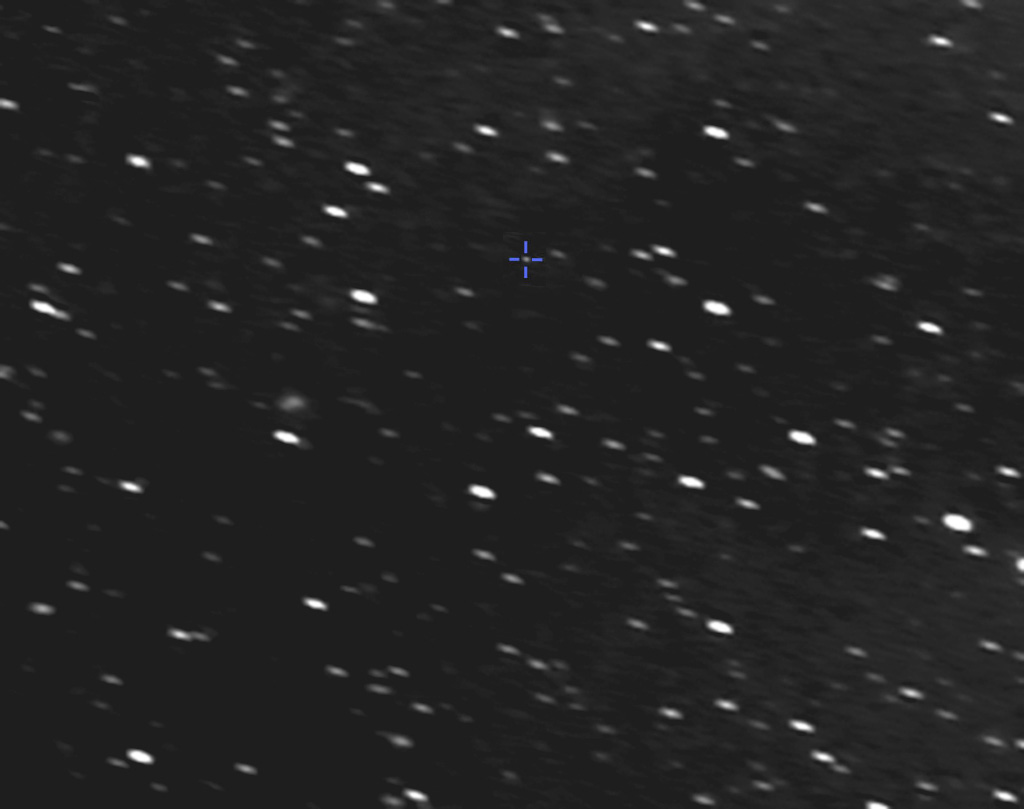
2822 Sacajawea marked.
Images acquired: 03:45 - 04:10 EST
February 6, 2005
SBIG ST2000XM CCD camera (clear, IR/UV-blocked filter),
5-inch F6 Astro-Physics refractor and 0.75x telecompressor,
Losmandy G11 mount, guided by the camera,
Maxim CCD/DL 4.07 image acquisition and processing software,
Finder charts and ephemeris generated by Guide 8.0.
David Cortner
Connelly's Springs, NC
|