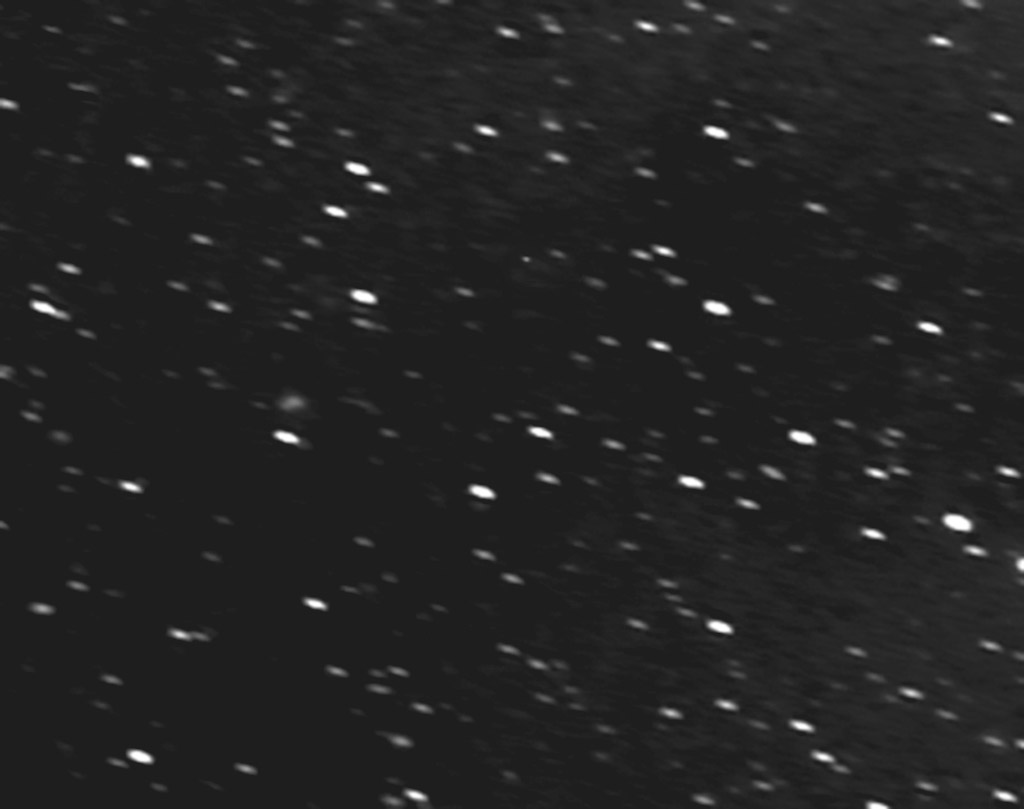
The small, sharp dot just above center is the asteroid 2822 Sacajawea. When I made this photograph on the morning of
February 6, 2005, it was about 221,000,000 miles from Earth,
gliding through a field of faint stars in Libra.
This asteroid was discovered 25 years ago by Edward "Ted" Bowell who now heads the Lowell Observatory Near Earth Object Survey. Here's the citation explaining asteroid 2822's name:
Discovered 1980 March 14
by E. Bowell at Anderson Mesa.
Named for the young Shoshone Indian woman who guided Lewis and Clark on their expedition of discovery across North America to the Pacific Ocean during 1804-1806. She displayed limitless courage and loyalty to both the expedition, in which she faced danger as bravely as any other member, and to her infant son, whom she carried for the entire trip.
Sacajawea's son—known as "Little Pompey" or just "Pomp" to the men of the expedition, as "Jean Baptiste" to his father, and perhaps as "Pompy" to his mother (the word means "Little Chief" in Shoshone)—was born on February 11, 1805, while the expedition wintered with the Mandan Indians near present day Bismarck, North Dakota.
David Cortner
Connelly's Springs, NC
Note about spelling: in the years since Ted Bowell named asteroid 2822 for Sacajawea, other spellings of her name have become common. "Sacagawea" with a hard "g" is one. "Sakakawea" is another. In these pages, I am sticking with the asteroid's official name, spelled with a "j".