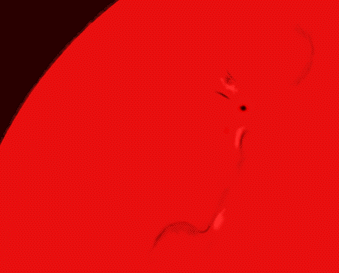
 In the morning and most of the afternoon on Saturday the show
was almost entirely on the disk. The lone sunspot anchored a lot of
activity. At different times, different parts of the two long filaments
were darkest and most eye-catching. Some very fine detail appeared and
disappeared in the space of five minutes -- especially the narrow "jet"
above the spot. Tuning the filter let me move the darkest portion of
the jet in and out, and by leaving the tuning constant, I could watch
the darkness progress along the same arc two or three times during the
course of the afternoon. Broad
"cobweb" structures sometimes came into view in the conspicuous arch shown
below the sunspot -- the intermittant visibility of this detail
I put down to changes in seeing rather than to physical changes on the sun.
Are bright patches actually associated with changes in direction in the
filaments? Or is this an illusion, some kind of contrast effect?
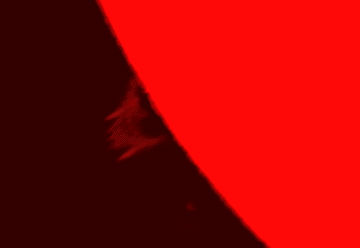
On Saturday, this was the only visible limb detail. I expected the limb
would be much livelier as the filaments finally rotated to it in a few days
and so kept the kit ready to go whenever the skies allowed [1996 Aug 31].
In the morning and most of the afternoon on Saturday the show
was almost entirely on the disk. The lone sunspot anchored a lot of
activity. At different times, different parts of the two long filaments
were darkest and most eye-catching. Some very fine detail appeared and
disappeared in the space of five minutes -- especially the narrow "jet"
above the spot. Tuning the filter let me move the darkest portion of
the jet in and out, and by leaving the tuning constant, I could watch
the darkness progress along the same arc two or three times during the
course of the afternoon. Broad
"cobweb" structures sometimes came into view in the conspicuous arch shown
below the sunspot -- the intermittant visibility of this detail
I put down to changes in seeing rather than to physical changes on the sun.
Are bright patches actually associated with changes in direction in the
filaments? Or is this an illusion, some kind of contrast effect?
On Saturday, this was the only visible limb detail. I expected the limb
would be much livelier as the filaments finally rotated to it in a few days
and so kept the kit ready to go whenever the skies allowed [1996 Aug 31].
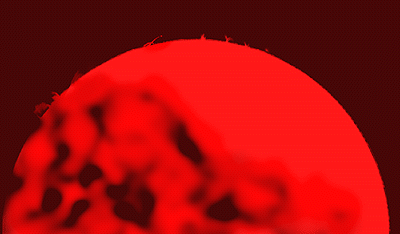 Rain suddenly gave way late in the day on Tuesday to hard
slanting sunlight -- the air, though unsteady, seemed as transparent
at the sun's low elevation as at the zenith. Those are tree limbs
encroaching on the sun's disk. The telescopic image is inverted --
the sun is moving "up" in this view into a clear space below the topmost
branches of neighbors' trees. For the record, it takes 6 minutes
to carry the 5-inch telescope, G-11 mount, an eyepiece and the
H-a filter out and be ready to take notes. The brightest parts of
these limb features were visible over 3/5ths or more of the filter's
tuning range, they were bright, contrasty, and very conspicuous.
As Jupiter does on a good night, they rewarded all available
concentration and showed more detail than the setting sun and nearby
treetops let me take down. I gather that I am seeing only the lowest
parts of the filament I've watched march across the sun's face over the
last several days -- the low elevation, the unsteady air, the hurried
nature of the observation all work against making out more of the
material (presumably) suspended above the limb. If that is so, maybe
next time (this active region should reappear around the trailing limb
on or about Sep 15-17, right?). [1996 Sep 3, 18:45 - 19:00 EDT]
Rain suddenly gave way late in the day on Tuesday to hard
slanting sunlight -- the air, though unsteady, seemed as transparent
at the sun's low elevation as at the zenith. Those are tree limbs
encroaching on the sun's disk. The telescopic image is inverted --
the sun is moving "up" in this view into a clear space below the topmost
branches of neighbors' trees. For the record, it takes 6 minutes
to carry the 5-inch telescope, G-11 mount, an eyepiece and the
H-a filter out and be ready to take notes. The brightest parts of
these limb features were visible over 3/5ths or more of the filter's
tuning range, they were bright, contrasty, and very conspicuous.
As Jupiter does on a good night, they rewarded all available
concentration and showed more detail than the setting sun and nearby
treetops let me take down. I gather that I am seeing only the lowest
parts of the filament I've watched march across the sun's face over the
last several days -- the low elevation, the unsteady air, the hurried
nature of the observation all work against making out more of the
material (presumably) suspended above the limb. If that is so, maybe
next time (this active region should reappear around the trailing limb
on or about Sep 15-17, right?). [1996 Sep 3, 18:45 - 19:00 EDT]
Previous
Next
 Take me home!