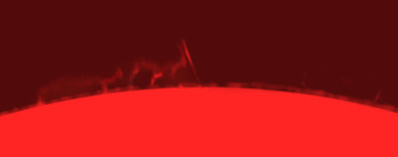
 Saturday, August 24, 1996 -- the first clear sunlight in almost
a week. The quiet Sun of last Sunday evening has changed. On the leading
limb (rotating out of view), I found this example of the rococo
architecture of the Sun. It was instantly apparent halfway through my
first trip around the Sun with the slow-motion stepper
motors. When its tallest spires approached the sweetest spot in the
filter's field of view, I froze the telescope's aim and tuned for maximum
contrast. The brightest bits faded last and reappeared first and they
were visible over a wider range of frequencies than the chromosphere itself
is. After taking a few minutes to sketch the general aspect of this
prominence, both to get it down (in case clouds returned) and to detect
rapid motions (if any), I completed my first circuit of my solar beat.
Almost oppositethese complex spires and arches, I found an amorphous haze
hanging above the Sun's trailing limb. With tuning, this cloud showed
some slight structure, but for the most part all careful examination went
unrewarded and I decided I was wasting time better spent elsewhere. I
didn't try a drawing of this other active region.
Saturday, August 24, 1996 -- the first clear sunlight in almost
a week. The quiet Sun of last Sunday evening has changed. On the leading
limb (rotating out of view), I found this example of the rococo
architecture of the Sun. It was instantly apparent halfway through my
first trip around the Sun with the slow-motion stepper
motors. When its tallest spires approached the sweetest spot in the
filter's field of view, I froze the telescope's aim and tuned for maximum
contrast. The brightest bits faded last and reappeared first and they
were visible over a wider range of frequencies than the chromosphere itself
is. After taking a few minutes to sketch the general aspect of this
prominence, both to get it down (in case clouds returned) and to detect
rapid motions (if any), I completed my first circuit of my solar beat.
Almost oppositethese complex spires and arches, I found an amorphous haze
hanging above the Sun's trailing limb. With tuning, this cloud showed
some slight structure, but for the most part all careful examination went
unrewarded and I decided I was wasting time better spent elsewhere. I
didn't try a drawing of this other active region.
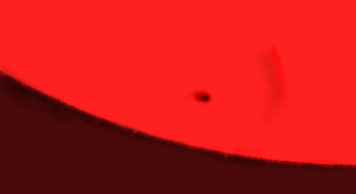 There was a lone sunspot close to one limb and I hoped a very careful
look at that limb might be interesting. Only a couple of slightly curved
and overgrown spicules grew anywhere nearby, so I attended instead to the
clearest detail I've yet seen on the face of the Sun. (Is this
face-on detail really more contrasty than before, or am I simply learning
to see it and to pay attention to it?) Preceding the spot was a shadowy
arc with the spot approximately at its center of curvature -- I have no
reason to think the two are physically related, since no dark or light
detail connected the spot to this arc. I take this dark region to be
a prominence seen in silhouette ("solhouette"?). It's of the same general
size (in terms of its angular extent along a great circle) as the larger
fields of prominences I have seen, and its most subtle shapes and shadings
(which I have not attempted to sketch) were reminiscent of a kind of
negative image of limb prominences. Its details were subtle at best.
I did not experiment with tuning to determine whether these details or the
filament as a whole appeared and disappeared over the same, or a wider, or
a narrower band of wavelengths than limb prominences do. Why do the best
experiments always come to mind too late to be tried?
There was a lone sunspot close to one limb and I hoped a very careful
look at that limb might be interesting. Only a couple of slightly curved
and overgrown spicules grew anywhere nearby, so I attended instead to the
clearest detail I've yet seen on the face of the Sun. (Is this
face-on detail really more contrasty than before, or am I simply learning
to see it and to pay attention to it?) Preceding the spot was a shadowy
arc with the spot approximately at its center of curvature -- I have no
reason to think the two are physically related, since no dark or light
detail connected the spot to this arc. I take this dark region to be
a prominence seen in silhouette ("solhouette"?). It's of the same general
size (in terms of its angular extent along a great circle) as the larger
fields of prominences I have seen, and its most subtle shapes and shadings
(which I have not attempted to sketch) were reminiscent of a kind of
negative image of limb prominences. Its details were subtle at best.
I did not experiment with tuning to determine whether these details or the
filament as a whole appeared and disappeared over the same, or a wider, or
a narrower band of wavelengths than limb prominences do. Why do the best
experiments always come to mind too late to be tried?

Fast Times at Sunspot Central!
I revisitted the amorphous cloud above the trailing limb, made out a little
more detail, but elected to go back to the showpiece on the leading
limb. I went back by walking the telescope around the limb, back the
same way I came. When the region of the sunspot returned to view, the
first thing I saw was a brilliant streak angling up from the
limb directly "over" the spot. It could not have been there
ten minutes earlier! On close inspection, it was not connected by spicules
or other visible structure to the surface of the Sun, and no feature of the
chromosphere where it "would" touch down seemed out of the ordinary.
Instead, it appeared to rise up from beyond the Sun's horizon.
I expected to see rapid changes in this new feature so I watched for
a few minutes. None were
forthcoming, so I recorded it as exactly as I could (get a pad
of graph paper!) and planned to return after another review of the
complex show on the leading limb.
When I came back to the spot 10 minutes after first seeing the bright line
above it, the streak was gone. No amount of
tuning would bring it back into view. There was perhaps a larger
than ordinary spicule near where this bright line had been, but certainly
nothing more. So -- did something erupt from the Sun? Or have I just
seen a "flickering" prominence of the sort the books describe which
appear and disappear as their gases are accelerated to and from the
observer and their light Dopplar shifted in and out of the tuning
interval (+/- 20A corresponds to how many miles/sec? I've only seen this
description applied to dark features seen against the solar surface where
rapid vertical motions are available to account for their changing
visibility, and I understood the range of wavelengths to be much
smaller). Or -- my current favorite guess -- am I seeing an extension
of that dark filament around and above the limb, a sheet of gas which
just happened to change its orientation in space such that for a few
minutes only I was coplanar with it? Perhaps it became visible only
when I looked along its length rather than across it? Is something
like this at work with the faint amorphous prominence -- am I seeing
something broadside which would appear brighter and more structured if
seen along a sight line which included a greater thickness? (And am I
now trying to make too much hay out of an already tenuous guess?)
All this speculation is fueled in part by the appearance of that tallest
spire in the leading edge feature -- it looks as delicate as an auroral
curtain, and not very different from one for all its difference in scale
and color. 1996 August 24. 12:00-12:35 EDT
Next Observations: Sunday
Previous Observations: Last Sunday
 Take me home!