Friday -- Yesterday and today were devoted to getting a 3.5-inch
Questar to work as a portable solar prominence 'scope. On Thursday, I
conducted "field trials" using the tiny off-axis aperture the OEM
(white-light) filter holder provides. While I could see that there were
clouds of crimson gas above the sun's limb and could make out the
"burning prairie," I saw very little structure in the prominences. For
the most part they seemed unconnected with the sun's limb, probably on
account of glare as the low-contrast prominence filaments require all
the contrast the optics can provide or else get lost adjacent the sun.
Thursday evening, I cobbled up a new filter holder for the Questar using
the lid of an "I Can't Believe It's Not Butter" margarine tub. Even
with the sun low in a very hazy sky, prominences were much better and
brighter. So I carried this to the University on Friday to try with
the sun high in the sky.
Much better! In fact, I was very pleased during the day and showed some
prominences to several people. (Three or four middle-aged men standing
around a telescope in the parking lot adjacent the womens' dorm... would
someone please explain what passersby found interesting about this?) The
telescope is about F18.5 and contrast is further enhanced by masking the
aperture down slightly from the full 77mm available; this is one easily
adjustable factor that needs to rigorous trials. I put the Questar away
until evening for side by side comparison with the 5-inch.
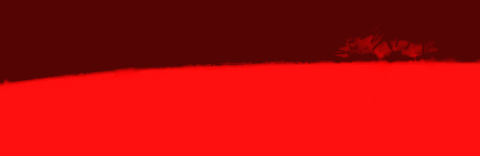
This is representative of the best views during the day using the
Questar, the 77mm filter pack in the "I Can't Believe It's Not Butter"
retaining bracket, and the 16mm Nagler eyepiece. I've flipped the image
around to match up the orientation in the 5-inch refractor. Below is
how the sun looked through the 5-inch with the same eyepiece, using the
63mm Maxwell House On-aXis Apparatus (MHOXA?):
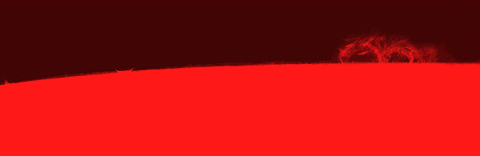
As for the Questar view, "I Can't Believe It's Not Better." Something
needs to be optimized if this is going to be my mid-day solar inspection
instrument for short winter days when I can't count on getting home in
time to bring the big guy to bear.
After retiring the Questar for further cogitation, I concentrated my
eyepiece notes on the most vivid prominence patch on the sun's leading
limb, preparing several diagrams and sketches to be used in getting the
appearance right.
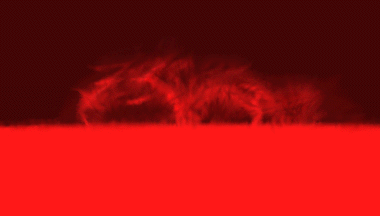
A curious "splash" well to the left of this elaborate
prominence is shown in the wider view above -- no further detail turned
up there, despite giving it lots of attention. [All: 1996 August 16,
18:10 - 18:40 EDT]
By Saturday morning, this feature had either
developed or come into better view; a "fountain" structure with faint
lobes graced this part of the limb, suggesting that the "splash" is just
the top of a larger structure that is now visible over the limb. The
large prominences from yesterday are still evident, but the northern
(right) side has collapsed / flattened and the loops to the left seem
less well defined. Seeing deteriorated very rapidly late Saturday morning
and cloud cover increased before I could gather enough notes to do much
with the limb detail. The seeing seemed much worse just downwind of
clouds, particularly in the 30-45 seconds just before the sun was
obscured. After 10:00 AM, the sky was too cloudy or hazy or turbulent
(or all three at once) to see much.
During the clearest (but not very steady) moments, I saw what I took to
be the last visible remnants of a departing prominence above the trailing
limb -- just a faint sheen 5 - 7 minutes above the sun with one involved
knot low in the structure (a down-pointing chevron). The whole, dim
structure appeared much-elongated (radially, from the center of the sun)
like a fun-house mirror distortion of something that might have once
resembled the the portal- and canopy-rich prominence drawn above.
During the steadiest (but not very clear) moments, I concentrated on
the structure of the "burning prairie" itself and could easily see
individual spicules which comprise the brightest portions. Lots of
variation in their individual height, brightness, and their "crowdedness"
around the limb. Many are not radial to the sun. They seem transparent,
as if the brightest clusters might be coincidental alignments of two or
three spicules, though there is plenty of room for individual brightness
variations as well. The distinction between the brightest clumps of
spicules and the smallest prominences is not so much a matter of scale but
of morphology: spicules seem to taper and to be very narrow indeed, like
needles, while even the smallest prominences seem much broader and more
varied in their shapes of their upper bounds.
Next Observations: Sunday
Previous: Wednesday
 Take me home!