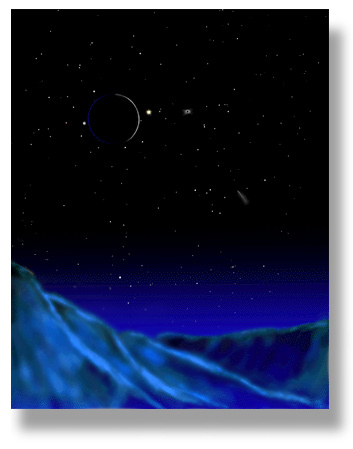
Europa Eclipses the Sun as Seen from Ganymede
16 July 1997
[Enlarge Details]
[Eclipses in Cyberspace]
[Go Home!]
[Back to Key]
According to Guide, this eclipse is total
over Ganymede's high northern latitudes, so in this
I've placed the observer at
about the equivalent of Greenland's earthly latitude and chosen a
longitude that would put Jupiter near the meridian.
Jupiter is 7 1/2 degrees wide in
Ganymede's sky (you could just about cover it with your fist).
Comet Hale-Bopp, a few months past perihelion, is diving below the
ecliptic in the lower right. At this moment, the sun is 6.27 arc minutes
in apparent diameter, and Europa is 6.30 minutes. (I'll work out the
eclipse duration shortly -- one to three minutes is my top-of-the-head
guess from playing with the computer.) Callisto is a very thin crescent
to the right of the eclipsed Sun, a whole array of the inner planets is
to the left.
Venus shines at -1.1 magnitude; Mars at 3.9; Earth (a very thin
crescent, only 4 arc seconds across) shines at a paltry 5.9. Callisto
is also a very thin crescent, a fraction of a circle 5.65 arc minutes
in diameter. Regulus is the bright star just left of Jupiter's dark limb,
and the Lion's head and mane curl around the top of Jupiter (the planet
is sitting in the big cat's paws as if Leo were playing with a beach ball).
I'm guessing that the light scattered around Jupiter by its
highest "air" would be blue. And while I suspect Jupiter's ring would be
visible at this phase (Jupiter is 0.86% illuminated), I have no idea how
brightly or at what angle it would shine, so I have left it out. The
glacial blue color on Ganymede's icefields is artistic license, as is
the slight "haze." The former may be defensible but the latter is purest
fantasy.