|
As a measure of just how small the angular dimensions involved in these observations are, note that Jupiter's moon Ganymede is about the same apparent size as a baseball seen from eight miles away. The sky was very transparent and the air cool (low 40's dropping slowly) under an "old" high pressure system retaining little of the turbulence of its arrival. In the illustrations below, the depictions of Ganymede and Europa on the left come from Bill Gray's extremely accurate sky mapping program, "Guide 8." To a fair approximation, Guide's images represent exactly what a perfect lens under perfect conditions would show. The drawings on the right depict what I saw. (I've never seen any surface detail on Ganymede, but tonight's success with tiny details suggests it is just a matter of time and a few more tweaks.) 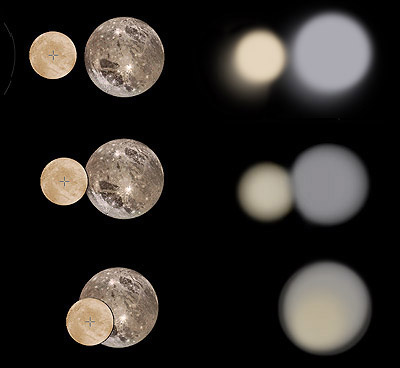
The first pair of drawings shows Europa approaching Ganymede at 00:53 EST when the two moons merged into one elongated image as seen through a 5-inch F6 refractor. (The view through the refractor suffered from lack of magnification. I was using only 107x.) When the moons blurred together in the small refractor, my attention turned to the view in the 16-inch reflector. Through a 12mm Nagler eyepiece and a 2x barlow lens (magnification 330x), the two moons looked like this. Although the centers of Europa and Ganymede were seperated by 1.5 seconds of arc, the edges of their visible disks were only 0.2 seconds apart. (Two tenths of a second of arc is approximately the distance between the eyes of a human face as seen from fifty miles away.) In the top right drawing, the "fans" of light extending down and to the left of the bright moons indicate that optical problems remain to be found and fixed. The 16-inch telescope uses only the center of an inexpensive 17.5-inch primary mirror. I long ago cut a plywood mask 16-inches in diameter and mounted it approximately concentric to the primary. The opaque ring hides the mirror's outermost surface and keeps its imperfect form from contributing unfocussed light to the view. The flaring shown in the drawing was worse without the 16-inch aperture stop in place, reduced when the stop was lifted toward the top of the mirror. Also, the spot of finest resolution was offset from the center of the field of view. Even so, I think the telescope did very well with a very challenging subject. (This telescope is a perpetual work in progress, see here.) The second and third drawings are based on observations through a small, 6.5-inch mask mounted to admit light that has not had to split around the internal structure of the telescope. This lack of interference is important, but on a steady night it's not as important as the simple fact that small areas of big telescope mirrors are truly excellent. Live with a telescope for a decade and you find out much, including where its sweet spots are. Looking through the 6.5-inch off-axis mask, the disks of the moons were much "cleaner," but the difference in their colors was less striking. Likewise, detail on the surface of Jupiter -- the Great Red Spot was transiting Jupiter even as Europa crossed Ganymede -- was more cleanly delineated with the small mask in place. Even so, it was sometimes easier to see fine detail in Jupiter's swirling clouds by their color differences than by simple differences in brightness, and for that the telescope worked best using its 16-inch aperture. The second set of renditions (00:56 EST) compares what Guide says was happening with what I saw when I judged the moons' visible disks to be just touching. I was a minute and a half late in this judgement. Trial and error right after this suggested that a different eyepiece yielded a sharper image, so I put the 12mm Nagler away and began using a 10.5mm Plossl with the 2x barlow lens (magnification 380x). I tried using even more magnification, but 571x through a 7mm Nagler and the barlow was unrewarding. I intended to note when Europa was no longer visible in front of Ganymede, but it soon became clear that this was not going to happen. The color contrast of the two moons sufficed to keep Europa easily visible as a golden highlight in the northern hemisphere of Ganymede. The third pair of depictions (01:04 EST) represents the point at which I could no longer say with certainty that any part of Europa protruded beyond Ganymede's limb. At that time, again according to Guide 8.0, only about 0.2 seconds of arc of Europa was "hanging out." The drawing represents the color contrast, and the strikingly dusky tone of Ganymede as seen with the full 16-inch aperture, but I have drawn it with the sharpness seen through the 6.5-inch off-axis mask. Three Surprises: (1) before tonight, I had always seen Europa as brilliant white. The warm tone in tonight's observations may have been a contrast effect. The "slate blue" impression of Ganymede is almost certainly an illusion. (2) I was astonished by the fineness of detail visible -- the interplay of very small disks and the very high contrast of black space behind them allowed extraordinarily fine details to be seen. The visibility of black spaces of extremely small angular width was especially surprising. I can only think that something akin to the process that permits fine wires to be visible at extreme distances is at work in these observations. (Think of telephone wires visible between poles at distances which would ordinarily render objects whose size approximates the thickness of the wire invisible). (3) In retrospect, it shouldn't have been surprising how much fainter was the combined moons' image, but I was surprised by how dramatically the brightness of the pair changed as the moons came together. Date: December 29-30, 2002. Site: 2 miles north of Rutherford College, North Carolina. Telescope: Twice-reborn Coulter 17.5 inch project scope. For a completely different look at another event involving the same two moons, go Eclipse Chasing in Cyberspace. davidcortner @ pobox.com |