 The American Association of Variable Star Observers was anticipated
by Professor Bond of Harvard College Observatory when he told the
young Hank Thoreau that there was plenty of work available to the
naked eye and to modest spyglasses in monitoring the brightness of
variable stars. Founded in 1911, the AAVSO has archived over 5,000,000
visual and photoelectric measurements of pulsating stars. When pro's
want to know what RU Cameloparlis was doing on some night half a
century ago, they ask the AAVSO. Likewise, if a modern researcher
wants to know when to turn his orbiting X-ray observatory toward
SS Cygni in order to catch it in outburst, likely as not, some amateur
will tell him.
The American Association of Variable Star Observers was anticipated
by Professor Bond of Harvard College Observatory when he told the
young Hank Thoreau that there was plenty of work available to the
naked eye and to modest spyglasses in monitoring the brightness of
variable stars. Founded in 1911, the AAVSO has archived over 5,000,000
visual and photoelectric measurements of pulsating stars. When pro's
want to know what RU Cameloparlis was doing on some night half a
century ago, they ask the AAVSO. Likewise, if a modern researcher
wants to know when to turn his orbiting X-ray observatory toward
SS Cygni in order to catch it in outburst, likely as not, some amateur
will tell him.
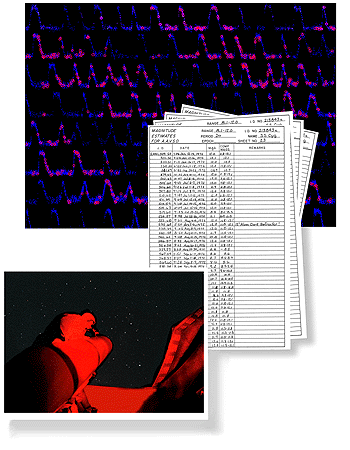
At top are several thousand observations of SS Cygni over a several-year
span. The "peaks" come 30-60 days apart. Each blue dot is one
observation. Each circle is an observation by George
Kelley, Jr., who gets a lot of ink in this book (we go way back). Each of
George's
observations begins under the stars in his backyard observatory, visually
comparing the brightness of the variable star to its constant neighbors.
Each estimate gets recorded in a ledger. Observations are collated monthly
and sent to HQ (all AAVSO observers refer to the home office as HQ, as in
HeadQuarters -- makes me think of "Twelve O'Clock High" (or "Car 54")).
We finish the book, and this pile of scraps, with an aside about
turning pro.