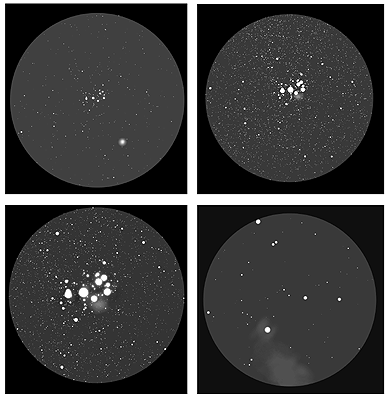
 At top left, Halley's Comet cruises by the Pleiades in November 1985
as seen through widefield Nikon 9x25's similar to the 10x25's
on the previous page.
Sure it would have been a better view with bigger glass, but
these are what Alvin Goldman and Holly Smith happened to have on hand
at a reception in Tucson for a visiting philosopher. I must have
introduced 20 people to Halley that night using their tiny glasses.
No one is intimidated by pocket binoculars and most people are
astonished by what they can see with them under a nighttime sky.
At top left, Halley's Comet cruises by the Pleiades in November 1985
as seen through widefield Nikon 9x25's similar to the 10x25's
on the previous page.
Sure it would have been a better view with bigger glass, but
these are what Alvin Goldman and Holly Smith happened to have on hand
at a reception in Tucson for a visiting philosopher. I must have
introduced 20 people to Halley that night using their tiny glasses.
No one is intimidated by pocket binoculars and most people are
astonished by what they can see with them under a nighttime sky.
At top right, 7x50's reveal fainter stars among the Pleiades and a
hint of the reflection nebulosity that swirls among that nearby cluster.
While the drawing at top left represents the view under pretty good
suburban skies, this one represents the view under inky, country skies.
As does this one, which shows still fainter stars as seen in my
favorite binoculars, the Fujinon 14x70's (from Mount Withington,
New Mexico, in fact -- you'll go here in the scraps from Chapter 7).
Binoculars sometimes beat the view in most telescopes: telescopes
look right through large open star clusters and into empty space.
Under really good skies, the reflection nebula remains as something
of a booby prize in the Pleiades, but don't count on seeing even that!
(The drawings are adapted from displays produced by Bill Gray's
"Guide" software which uses the Hubble Guide Star Catalog and host
of other data catalogs to let computers generate interactive deep-sky
atlases.)
Back to the Table Scraps.