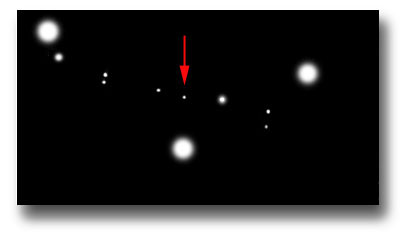
1998, October 17, 11:00PM EDT, Based on Sketches by Paul Sventek and David Cortner.
David Cortner
It took me two nights to starhop to this inconspicuous place. I somehow
kept getting lost traversing just two degrees of sky between my best
guidestar, 20 Ceti, and the faint asterism drawn above. On October 16,
George Kelley used his 12.5-inch reflector to search the area. He showed it
to Don Hurless, to Gus Johnson, to Paul Sventek, and to me. We knew Carolyn's
planet was somewhere in the field, but the 12.5-inch just didn't have enough
light grasp to reveal it. George told Don, Carolyn's husband, that he could
be sure that some of the photons from 3434 Hurless were streaming through
the eyepiece, even if there were too few of them for us to see the
asteroid.
On October 17, I finally located the field in my 16-inch F5 Dobsonian.
Through a low-power 35mm Panoptic eyepiece (selected for its wide field of view)
I could see no deeper than we had seen the night before using George's 12.5-inch
telescope with more magnification. I exchanged the 35mm Panoptic for a 16mm
Nagler. With a little more than twice the magnification, I expected some
improvement in limiting magnitude. The extra magnification
made a substantial difference: I immediately saw much deeper into the field.
When I saw the double stars shown to the left and right in Paul's drawing, I knew
we had a good chance to see 3434 Hurless. The fainter components of these
doubles were about as dim as we expected the asteroid to be. The Hubble Guide
Star Catalog lists these stars as magnitude 15.6 and 15.1 while we expected
3434 Hurless to be between 15.4 and 15.1. The GSC's magnitudes are usually a
little pessimistic -- many stars are really a little brighter than it indicates
-- so I expected the asteroid to appear fainter in the eyepiece than those
stars did. I knew from a finder chart generated using Bill Gray's Guide
software that the asteroid should be somewhere in the apparently empty space
above the bright field star at the bottom of the drawing. ("Bright" is a
relative term. At 10th magnitude this beacon in the eyepiece was 30 to 50
times too faint to see with the naked eye; at best, 3434 would be 100 times
fainter). I looked away from where I expected the asteroid to be, directly
toward one of the faint double stars. This let light from the "empty" part
of the field fall on the most sensitive part of my eye. Using averted vision,
I immediately saw a faint star in approximately the right spot. Gus had gone
inside with asthma; Don had gone to bed; George was close by in his
backyard observatory using a Lumicon UHC filter to examine the Helix Nebula.
Paul waited a turn beside my telescope. I stepped down from the short ladder
needed to reach its eyepiece and told Paul there was something there. I
didn't describe it any more than that.
Paul climbed to the eyepiece and studied the field for a while. He used a dim
red flashlight to check and recheck our chart. Then he told me that he
saw two stars in the area where the chart showed none. I returned to
the eyepiece. Paul reminded me to hyperventilate (this temporarily floods
the brain, including the visual cortex, with oxygen -- deep vision is sometimes
an aerobic exercise; if that's all wet physiologically, then perhaps breathing
deeply simply helps concentration or clears the mind). I breathed deeply a
few times, settled down behind the eyepiece, shielded my eyes from all scattered
light and readily saw both stars. Sometimes one seemed brighter, sometimes the
other. Both were plainly visible in the eyepiece, but neither star was shown on
our finder chart. Which star, if either, was 3434 Hurless? While Paul and
I pondered this, George drifted out from his observatory, climbed to the
eyepiece and also saw the twin stars deep in the belly of the celestial
Whale.
There were two ways we could be sure one star was Carolyn's planet. The most
direct was to wait a few hours and see if either star moved. 3434 Hurless
would be moving slowly to the left against the background stars as the Earth
overhauled the asteroid on our faster, inside track around the Sun. In 2
hours the asteroid would shift one minute of arc, 1/60 of a degree. I suggested
instead that we go inside and sketch what we had seen and then compare our
drawings to photographs I had made of the same field a week before. If
one or the other star was missing from the photographs, we could be sure
it was the asteroid.
My week-old negatives proved barely deep enough. The star we both thought
was probably 3434 Hurless -- the "star" Paul first saw -- was not on the film.
Unfortunately, it was a very near thing: its neighbor -- the star I first saw --
was recorded very weakly. We agreed that it was just possible that there was
a slightly fainter star in the place we both hoped we had seen 3434 Hurless, just
a bit too faint to be recorded on the film but just bright enough to be
glimpsed in the eyepiece.
The web is sometimes a wonderful thing. We decided to try to find a digitized
version of the very deep Palomar Sky Survey online. Using George's Internet
connection, we asked for an image of the sky near 20 Ceti going to magnitude 21
or deeper. An image like that would show stars a hundred times fainter than
any we could possibly have seen. The Digitized Sky Survey would tell us at a
glance if there was an imposter in the field: any star we could have mistaken
for the asteroid would stand out clearly. Unfortunately, we failed to find a
site that could fulfill our request.
While Paul searched the Net, I packed up my 5-inch Astro Physics refractor,
its heavy mount, guiding electronics, cameras. I left the 16" telescope for
my friends to use if the weather held for another night. Amy and I drove
home to North Carolina. In our kitchen at 2:30 on Sunday morning, I processed
the night's film and saw that I had a good image of the starfield. A photograph
made through the refractor just before we found the right area in the 16-inch
telescope showed both stars clearly and showed no others in the immediate
area. Best of all, during the 20 minutes the shutter was open the star we
thought likely to be 3434 Hurless appeared to have moved. Squinting at the
wet negative through an 8x loupe, I could see that its image was elongated. In
a frame filled with hundreds of clean, round star images, this object's
image was stretched out by just the right amount (about 1/200 the apparent
diameter of the Moon) and in just the right direction (along the asteroid's
predicted line of travel). I knew there was still a tiny chance that this
out-of-round image was really an unresolved double star, but when I saw the
short streak on the negative I was almost sure we had succeeded.
Here's my photograph.
My remaining doubts could be dispelled only by a deep, razor-sharp image, one such
as the Digitized Sky Survey could provide. I wanted to see a DSS image and in it
I wanted to see empty space where we had seen sunlight glinting from the surface of
a tiny world. Where my negative showed an almost microscopic hyphen I wanted to
see blank screen.
In the small hours of the night, I emailed a description of my photograph to
George and asked him to scan Paul's drawing and send it to me. Then I
went to bed.
When I awakened and checked my email, I found Paul's drawing attached to George's
reply. I also learned that Murray Cragin, one of George's and Paul's electronic
correspondents, had succeeded in generating and downloading a Digitized Sky Survey
image of our field. George forwarded this to me, too. Using Photoshop, I
inverted, cropped, resized and rotated the Sky Survey image to match
the scale and orientation of Paul's drawing. Where we three had seen
a feeble star, where I had photographed a moving pinpoint, there was nothing.
We believed we had seen the asteorid at the eyepiece. We were more confident when
our impressions and drawings matched. Comparing our sketches to the marginal
negatives from a week before made us surer still. When I processed the night's
photos in a kitchen-turned-darkroom 85 miles away, I was almost convinced. When
we got the Digitized Sky Survey image, we were certain. We had seen the light of a fainter Sun falling
on a small world, 3434 Hurless, a planet the size of a small city, probably no rounder
than an Irish potato. It was gliding in its long orbit against the stars of Cetus.
Antoine De Saint-Exupery's Little Prince prized the sight of his tiny planet because
of the presence of a single, unseen rose. 3434 Hurless is also prized for something
unseen. It is a planet named for a friend.
All of us involved in the search for 3434 Hurless wish to thank Brian Skiff, discoverer
of 1981 VO at Flagstaff Observatory's Anderson Mesa Station, who named his discovery at
Paul's request in honor of Carolyn Hurless, amateur variable star observer and astronomical
ambassador extraordinaire.