JUST ONE NIGHT...
These photos of Comet Hyakutake (1996-B2) were all made the
night of March 23 - 24, 1996, from George Kelley's farm (ranch?) outside
Glade Spring, Virginia. (This is like my second home: if you think
of it overlooking the Middle Fork of the Holston River the way
Monticello overlooks Charlottesville you won't be far off.)
As usual, these images are copyright 1996 by David Cortner. Use them
for wallpaper etc at your whim, but please email me for higher res
and customized versions for publication.
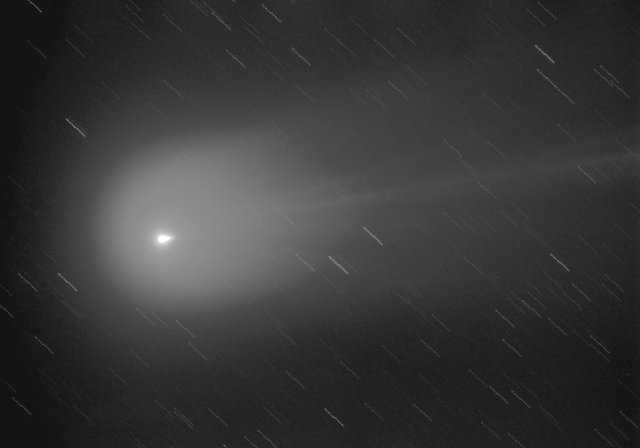
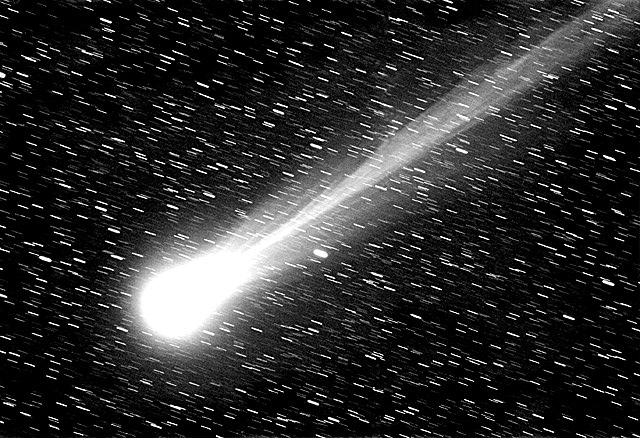
5-inch, Composite in B/W 152k.
A composite of 15 sec, 1 min, and 12 min exposures, grayscale.
This image mimics the best of views in 14x70 and 14x100 binoculars and
with a wideangle eyepiece behind the 5-inch refractor.
(This is my favorite of the bunch!)
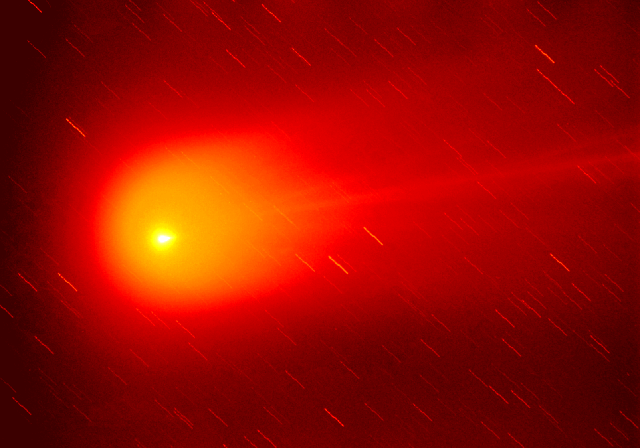
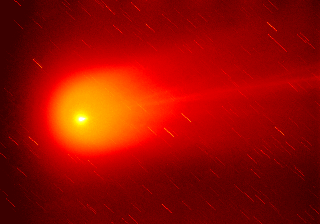
5-inch, Composite Color-Coded 152k.
Same image as above, but nicely color-coded to emphasize features of
radically different brightnesses. Also to leave viewers
properly slack-jawed, of course. (Maybe this is my favorite.)
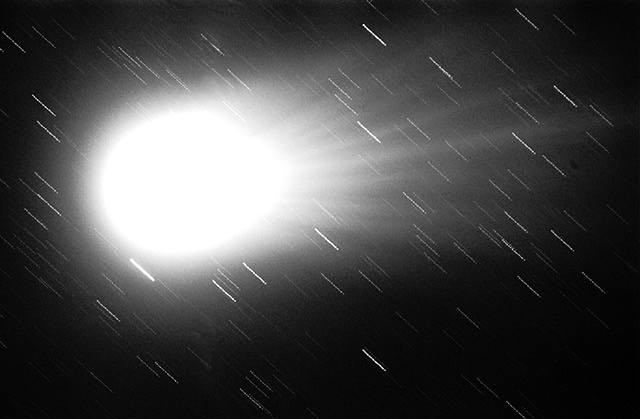
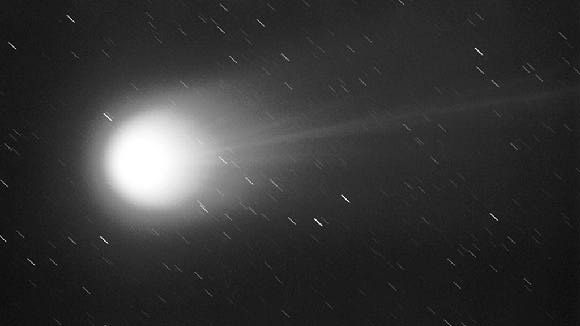
12 minutes, 5-inch refractor @ F4.5 22k.
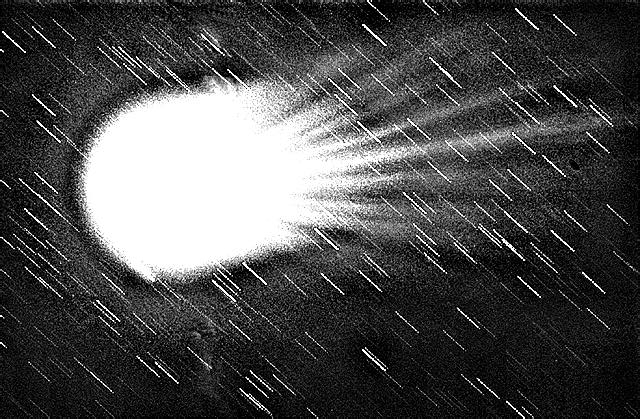
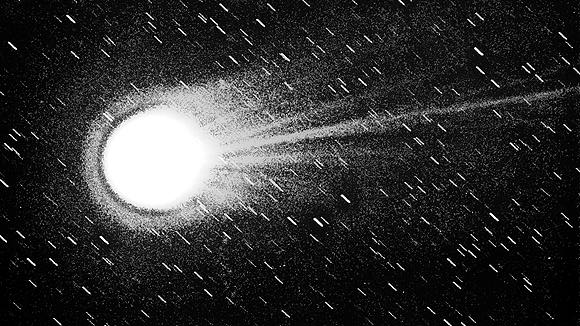
5-inch, 12min, unsharp masked 92k.
The previous image with aggressive unsharp masking and image subtraction
to emphasize streamers in the tail emerging from the coma.
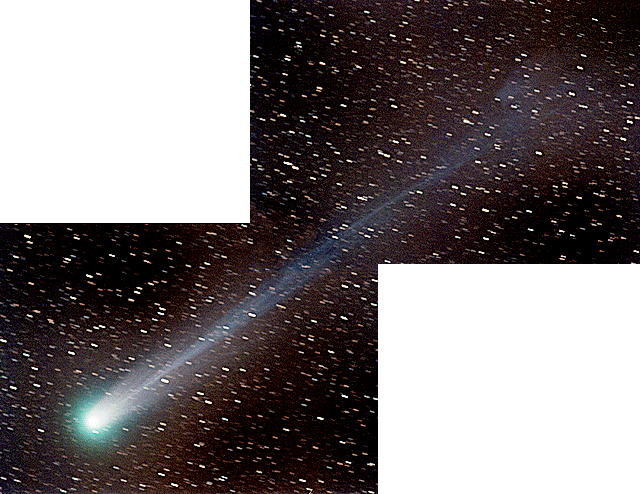
135mm Nikkor, 20 min @ F4 118k.
135mm Mosaic, Color 158k.
A mosaic of 2, 20 minute exposures on Fuji 800 (unhypered)
through the 135mm lens at F4.
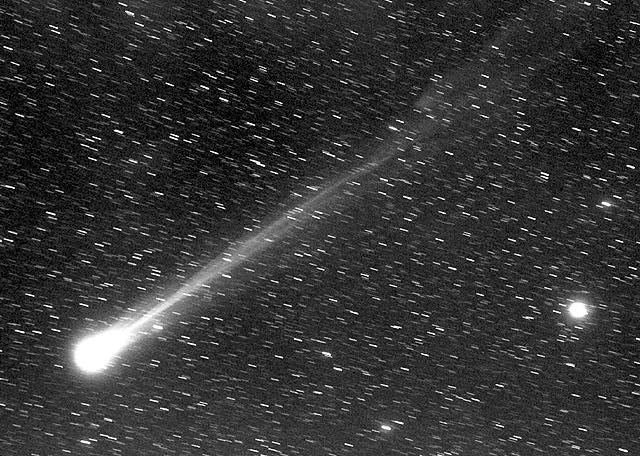
30 minutes at F5.6, 55mm Micro-Nikkor 80k.
The dynamic range of the image has been stretched to reveal 30 - 35
degrees of tail.
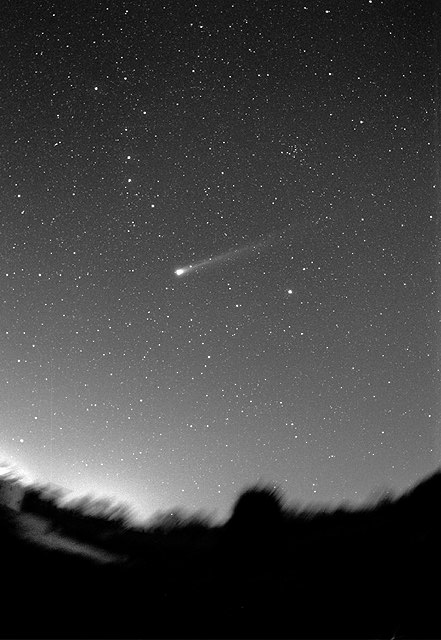
Fisheye 64k.
10 min at F3.5, with a 16mm Nikkor Fisheye. The film was Fuji 800 but
I have rendered it in grayscale to save download time. Image shows
the comet "in context" under the Dipper, with the Coma Star Cluster and
the rest of the eastern sky. The last snow of winter 1996 is in the
foreground, lit by a crescent moon.
5-inch, 3 minutes on TechPan 12k.
Previous image, aggressively sharpened 60k.
Technical Arcana, for them what care: All the black and
white images (except one, noted) are on Technical Pan film hydrogen
hypersensitized by Lumicon and processed for 7 minutes in D-19 at
22oC. The refractor is an early 5-inch F6 Astro-Physics apochromat
telecompressed to F4.5 and working through a minus-violet filter.
The refractor is carried on a Celestron (Losmandy) G-11 equatorial
mount. A venerable 3-inch Unitron serves as guide 'scope. The
images were digitized from the negatives using a Polaroid SprintScan
35. All scanning and post-processing were done in Photoshop for Windows
using Kai's KPT Convolver for the more aggressive moves.
Questions? Try some
mail bonding.