|
CCD Notes
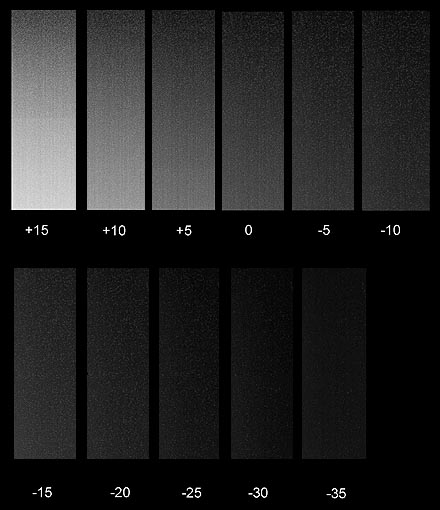
July 22, 2004 Connelly's Springs, NC. 77o in the kitchen by broad daylight. "In a dark time, the eye begins to see." -- Theodore Roethke 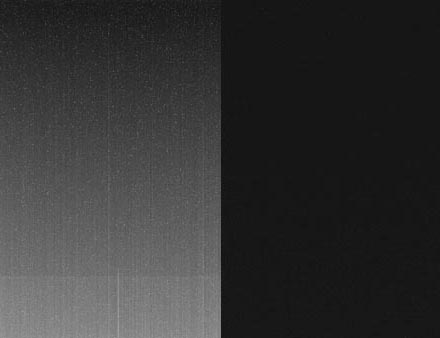 60 second dark frames processed identically. Right: +15C, Left: -37C Dark frames at more realistic temperatures shown below. The SBIG 2000XM is built to accept water cooling. In summer, when air temperatures run 70-80 degrees F, it's the only way to chill the CCD anywhere near its best operating temperature. How well does the water assist work? What difference does the added cooling make? The air in the kitchen was 24-25oC. I filled a 2-gallon bucket with cold tap water, submerged the pump, turned it on and let the water circulate in the bucket while I took dark frames using only single-stage cooling. I wanted to see if the pump alone would heat the water. Using a Beseler thermometer intended for color film processing, I couldn't measure any rise in the water temperature over a period of almost an hour. Maybe if it were colder the motor-generated heat would matter more. Set point: -15oC. With no water assist, the camera reached -14.8 with 100% cooling. The chip temperature drifted up to -14.4 during a 600 second dark frame. That's just less than 40 Celsius degrees below ambient temperature or five degrees better than SBIG advertises. While taking data, I messed with the pump. It moved 2 cups of water in 20 seconds with no lifting. Lifting 2 cups of water 1 foot took 30 seconds, and lifting the same water 2 feet took 60 seconds. I raised the middle part of the hose three feet and brought the end back down to the original level to confirm that the pump would move 2 cups of water "over the hump" in 20 seconds. Lesson: keep the loop closed and the height of the camera shouldn't matter much. Within reason. I hooked up the camera and asked it to cool to -25oC. I doubted it could reach that temperature, and it couldn't. After 15 minutes, the chip stabilized at -20.9o (100% cooling). That's 45-46 degrees below ambient and that's exactly in line with SBIG's advertised performance. I took a 600 second dark frame at -20o (96% cooling). By the time the exposure ended, the water in the bucket had warmed 0.3 degrees (to 21.8oC). The return water from the camera was 22.4o. SBIG says to resist the temptation to dump ice in the cooling water. I couldn't remember why. So I tried it. With the water chilled to about 5oC (guessing, because the thermometer doesn't read this cold), the camera quickly reached -25oC and stabilized there with only 75% cooling. The ice melted rapidly (two trays of cubes didn't last long in the original 2 gallons of tap water). I dumped most of the water, added much more ice. I assume the water was effectively at 0oC after this. I set the camera to -35C, which is supposed to be its optimum imaging temperature. It reached that temperature quickly at 100% cooling, backed off to 96% after two minutes, and stabilized at -35C and 93% throughout a 600s exposure. I set it to -40C to see just how cold it could get. It bottomed out at -37.1C where I took a 60 second dark frame. The camera case was quite cool to the touch, but only a trace of dew formed on it (it was in an air conditioned house). For comparison with this coldest frame, I took additional 60s dark frames while warming the camera back up to near ambient temperature. I completed the set of 600s exposures and bias frames along the way, too. Today's data: five bias frames and two dark frames (60 and 600 seconds) at 5 degree intervals from +15C to -35C. This should be a great mine for a data whore. By the time I was done, I'd melted "some" but not "a lot" of supermarket ice (maybe 3 pounds) plus the original two trays full.
The difference between -15 and -25 is pretty dramatic (that's the difference
water cooling makes on a warm summer night). The difference from -25 to -35 looks
less dramatic (that's the difference between dumping ice into the water
bath and using tap water). Is it really less dramatic? Looking closely, the
background at -35 is more uniform than the background at -25, so the last
ten degrees do matter. How much? It's going to take some quantitative analysis
to see the difference and some experience to know how much it matters.
Here's a statistical description of the same frames (measurements
made using Maxim 4.02):
Every degree counts! Going from -35C to -37C produces a
measurably quieter image even in a short, 1 minute exposure (look
at the standard deviation among the two million pixels). In ten
minute exposures, the standard deviation is cut in half
for every ten degrees of cooling. That implies that noise is
reduced by 7% for every degree of cooling (because the tenth root
of 1/2 is 0.933).
|