Touching the Stone
by
George Kelley, Jr.
In the year 1970, I began making systematic observations of variable stars.
Not all stars are constant in their brightness. Some are multiple star
sytems in which one star eclipses another causing variations in their
combined light; some single stars pulsate over periods of days,
weeks, or months; some multiple stars exchange material, often with
explosive results; some stars, if massive enough and near the end of
their lives, literally collapse and then tear themselves apart in a
tremendous outpouring of energy that for a short time exceeds the
total energy expended by all the stars in an entire galaxy. Variable
star observers salivate over such things.
Watching the variation in the brightness of stars is not simply a
game. Variable star observers faithfully record their observations
and report them monthly to a central repository. There the information
waits for professonal astronomers who use it in their studies to
determine the nature, evolution, and ultimate fate of stars.
Soon after becoming an observer and measurer of variable stars, I
became friends with a wonderful person in Ohio. Carolyn Hurless
was outgoing, enthusiastic, possessed of an inquiring and brilliant
mind. Each year, in August, Carolyn invited her variable star
observing friends to visit her and her husband Don for a weekend of
good food, endless conversations and music. Among my fondest
memories of variable star observing are memories of these
"August Orgies" as Carolyn named them.
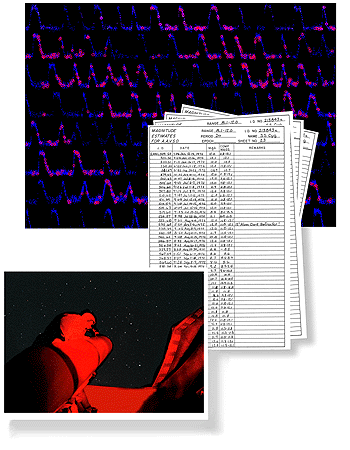
At left, George Kelley, Jr., lines up the 12.5-inch reflector
in his backyard observatory to observe the cataclysmic variable
SS Cygni. Blue dots on the graph represent several years of
observations by all AAVSO members; purple circles are George's
observations; pages of notes record estimates of the star's
brightness -- one estimate per line.
Carolyn's friends were deeply moved and saddened by news of
her untimely death on February 13, 1987. One of our number, Paul
Sventek, native Chicagoan, now a resident of Houston, TX, met
Lowell Observatory staff astronomer Brian Skiff when Brian
addressed a gathering of amateur astronomers in Houston.
Over the years, Brian has discovered several asteroids. These
small "planets" generally inhabit the space between the orbits
of Mars and Jupiter.
Now, the discoverers of asteroids are allowed to name their
discoveries once their orbits are well established. Paul prepared
a formal nomination and asked Brian to name one of his discoveries
for our friend Carolyn in memory of her and in honor of her
contributions to astronomy. Brian agreed to do so. When the
orbit of the asteroid formerly known by the preliminary designation
"1981 VO" was settled, the International Astronomical Union gave
the asteroid the number 3434 (in order of discovery) and the name
"Hurless." (Carolyn's friends are pleased with a coincidence
involving the two pairs of digits, 34 and 34: 1934 was the year
of Carolyn's birth.)
Not long after Carolyn's asteroid was named, David Cortner
calculated when over the next few decades the asteroid would
come nearest Earth. Our best viewing opportunity would come in
early October 1998. Even then, the small planetoid would be a
faint object, testing the limits of our vision and the
largest telescopes we owned. What better way to continue our
tribute to Carolyn than to attempt to see the asteroid named for
her? That thought simmered in the backs of our minds over the
years. The summer of 1998 rolled around. David said to me, "Hey
George, let's get the gang together and go for 3434 Hurless."
Invitations went out to Carolyn's husband Don in Ohio, to Paul
in Texas, and to Gus Johnson in Maryland. The weekend of October
17th was chosen to assure us of a sky unpolluted by the light of
the Moon. It did not assure us of clear weather, but October is
statistically the clearest month of the year in southwest Virginia.
The first night of our search was clear. The asteroid, however,
was located in an area of the southern sky devoid of bright stars
from which to begin our "star-hop" to its mapped position. After
three or four attempts, I managed to use my 12.5" reflector to
locate the field of stars in which Carolyn's namesake lurked.
Try as we might to see it, it eluded us. A defeated group of
observers went to bed after 1 A.M., Saturday, still yearning for
a glimpse of the elusive hunk of space rock.
Saturday evening was clear as well. While Don, Gus and I shared
telescopic views of the heavens with local visitors, Paul and
David undertook to locate the position of the asteroid in David's
16" reflector. Finally, at 11 P.M., David and Paul reported an
extremely faint object near the calculated position of 3434
Hurless. I also took a peek, and sure enough, there glimmering,
oh so faintly, was a "star" where star charts showed none. But
we still would not claim victory until gathering more evidence.
Our friend Murray Cragin down in Florida sent us by e-mail a chart
that showed stars much fainter than the asteroid. With that chart
in hand, we were certain we had not seen a star: we had seen
3434 Hurless. On Sunday afternoon, we finally declared our search
a success. We had come full-circle: we had figuratively touched
the stone named for our friend.